
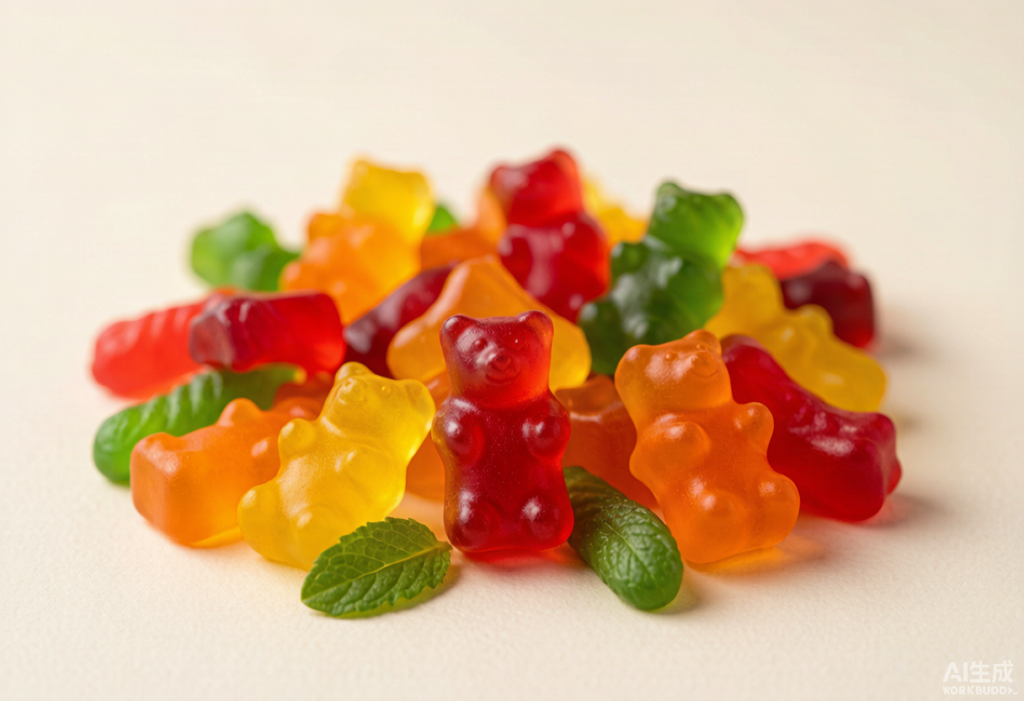
Gummy candy owes its famous bounce to one protein: gelatin. Soft, chewy, and remarkably stable, gelatin gummies fill store shelves worldwide, and the gelatin gummies manufacturing process behind them runs far more precisely than shoppers realize. A few degrees of temperature error or a mismatched Bloom value can turn a perfect batch into a sticky, cloudy mess.
That precision explains why this guide exists. We walk through the entire production chain — ingredient ratios, cooking parameters, molding choices, drying conditions, and the defects that surface when any step drifts. Every number below comes from food-engineering practice and production-line data, so formulators and buyers can act on it.
Why Gelatin Makes Gummies Work
Manufacturers extract gelatin from collagen in bovine, porcine, or fish sources. Heat the protein in water and it dissolves into a clear liquid; cool it and the chains reform into a reversible gel. That thermoreversible behavior — melt on heating, set on cooling — gives gummy lines their simplest advantage: producers pour a warm liquid, let it set, and get a chewy solid without any chemical reaction.
Three gelatin properties steer candy quality. Bloom measures gel strength, and higher values mean firmer, faster-setting gels. Viscosity governs how smoothly the liquid fills molds. Clarity decides whether the final piece looks bright or dull. Together these three numbers let a formulator dial in texture without guesswork.
Core Ingredients and Typical Formulation
Every gummy recipe builds on the same skeleton. Gelatin supplies structure, sugars provide sweetness and body, and small doses of acid, flavor, and color finish the product. Commercial batches typically fall into these ranges:
| Ingredient | Share of formula | Job in the gummy |
|---|---|---|
| Gelatin (150–250 Bloom) | 5–15% | Gel structure, chew, set speed |
| Glucose syrup | 40–60% | Body, prevents sugar crystallization |
| Sugar | 20–30% | Sweetness, dry matter |
| Water | 8–15% | Dissolving medium, final moisture |
| Citric acid | 0.5–1.5% | Sour note, shelf-life control |
| Flavor & color | 0.1–0.5% | Taste and appearance |
Two formulation rules protect every batch. Add acid after the gelatin dissolves completely, because strong acid hydrolyzes gelatin and weakens the gel. Keep the syrup rich in glucose syrup as well, since its long sugar chains stop sucrose from crystallizing and turning the gummy gritty.
Beyond the ratio table, ingredient quality sets the ceiling. A consistent 225-Bloom gelatin behaves predictably kettle after kettle, while an off-spec batch forces constant rework. That consistency gap explains why serious producers demand certificates of analysis, not just samples.
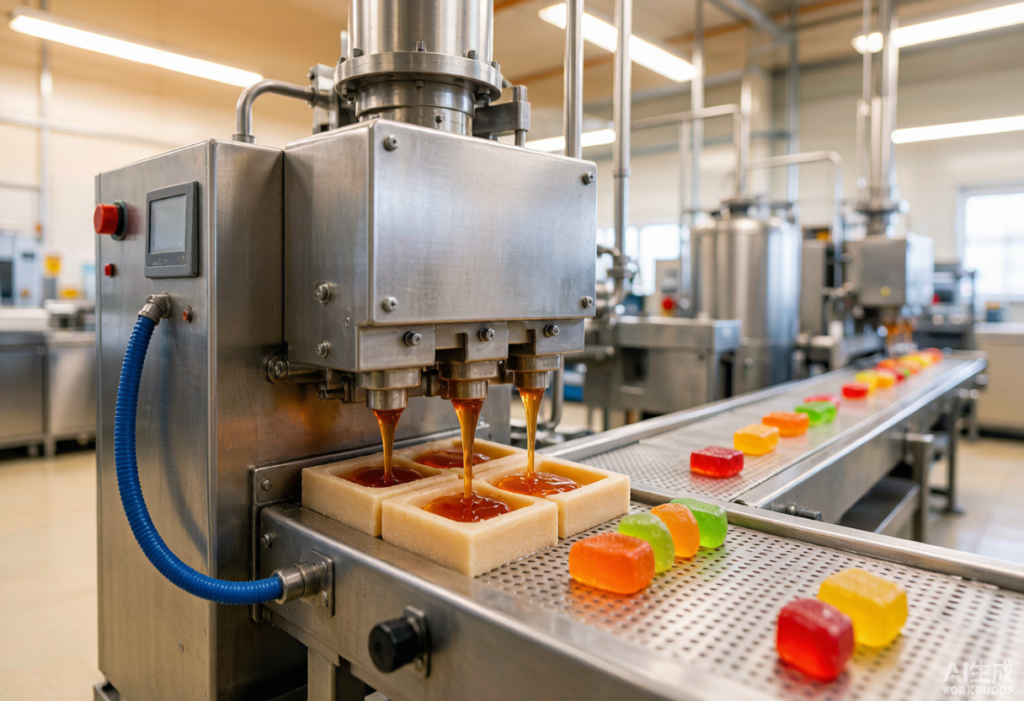
Step-by-Step: The Gelatin Gummies Manufacturing Process
Industrial production flows in one continuous loop: dissolve, cook, deposit, set, dry, and finish. Modern lines reach 2,000–2,500 kg per hour, with PLC systems holding every temperature and fill weight. All routes pass through the same eight stages.
Bloom the gelatin
Mix gelatin with cold water (below 20°C) and let it hydrate for 20–30 minutes. The granules swell into a thick mass; this “blooming” step prevents lumps and guarantees a smooth final texture.
Dissolve in a warm water bath
Melt the bloomed gelatin at 60–70°C. Never boil it, because high heat denatures the protein and destroys its setting power. Gentle heating keeps gel strength fully intact.
Cook the sugar syrup
Boil sugar, glucose syrup, and water in a vacuum cooker to 110–120°C at roughly −0.08 MPa. Vacuum cooking drives moisture down to 15–18% without caramelizing the sugars.
Mix and add color, flavor, acid
Combine the syrup with dissolved gelatin, then dose color, flavor, and citric acid through a mixing head. Automatic CFA (color-flavor-acid) systems add each ingredient precisely at the right moment.
Deposit into molds
Pump the warm liquid into starch or silicone molds through a depositor. Servo-driven pumps hold fill accuracy within ±0.5 g per piece, even at 25–32 trays per minute.
Set and cool
Filled molds travel through a cooling tunnel or setting room while gelatin cross-links into a firm gel. Starch molds need 12–24 hours at room temperature; silicone molds set faster.
Dry and demold
Starch-molded gummies dry 24–48 hours at 25–30°C and 40–50% humidity until moisture falls to 8–10%. Shakers and air blowers then separate candy from starch, and sieves reclaim the starch for reuse.
Polish and package
Tumble gummies in a polishing drum with food-grade coating oil — beeswax or carnauba wax — to prevent sticking and add shine. Metal detectors, checkweighers, and vision systems inspect every piece before packing.
Starch Molds vs. Silicone Molds
Depositing technology splits into two camps, and that choice shapes everything downstream. Starch moguls press impressions into trays of conditioned cornstarch; silicone molds use reusable, flexible cavities, often mounted on a continuous belt. Each system wins in different scenarios.
| Factor | Starch mogul | Silicone molds |
|---|---|---|
| Output scale | High volume, 2,000+ kg/h possible | Medium scale, faster changeovers |
| Shape detail | Simple, standard shapes | Complex, detailed shapes |
| Setting & drying | 12–48 h in starch + drying room | Sets fast, little or no drying |
| Mold cost | Low, starch recycled | Higher initial tooling cost |
| Space & energy | High (drying rooms, reclaim systems) | Compact footprint |
Many modern plants run both systems side by side: starch moguls for flagship volume shapes, silicone lines for premium, detailed designs and rapid product launches. Starch itself needs monitoring too, because particle size, moisture, and microbiology all affect whether pieces demold cleanly. That monitoring load explains the higher space and energy bills of mogul lines.
Choosing the Right Gelatin Bloom
Bloom tops every formulator’s checklist. It measures the force a gel resists under standardized conditions, and it maps directly to texture: higher Bloom means a firmer bite. Gelatins range from roughly 100 to 300 Bloom, while gummy production clusters in the 150–250 window.
| Bloom range | Texture result | Typical candy use |
|---|---|---|
| 150–180 | Soft, tender, quick melt | Marshmallows, soft chews |
| 200–220 | Classic gummy chew, balanced | Bears, worms, rings |
| 225–250 | Firm, snappy, long chew | Sour gummies, hard-texture lines |
Blending offers another lever. A formulator can mix an 180-Bloom gelatin with a 250-Bloom grade to hit an intermediate texture or tune set speed. When ordering, request Bloom, viscosity, and clarity on the certificate of analysis — those three values predict almost everything about how a batch will behave.
Common Quality Problems and Fixes
Even disciplined lines meet the same handful of defects. Most trace back to temperature, moisture, or ingredient timing. Use this table as a field guide:
| Problem | Likely cause | Fix |
|---|---|---|
| Sticky, tacky surface | Under-drying or high humidity | Extend drying time; check room humidity (target 40–50%) |
| Soft, won’t set | Gelatin overheated or wrong Bloom | Never boil gelatin; verify Bloom and dosage |
| Cloudy gummies | Air bubbles or poor filtration | Vacuum deaerate; filter syrup before depositing |
| Brittle, cracked pieces | Over-dried or over-acidified | Shorten drying; add acid later in the mix |
| Gritty mouthfeel | Sugar crystallization | Raise glucose syrup share in the formula |
| Sticks in molds | Starch moisture off-spec | Recondition starch; adjust tray density |
Golden rules of gummy production
Never boil gelatin — heat above ~85°C permanently weakens its gel.
Add acid last — acid hydrolyzes gelatin if it sits in the hot mix.
Avoid pineapple and papaya — their enzymes break down gelatin proteins.
Dry slowly — fast drying cracks the surface and traps moisture inside.
“Modern depositors use servo or precision pump systems to control fill volume, speed, and multi-shot layering for two-tone or filled products.”
What Buyers Should Ask a Gelatin Supplier
Gelatin for candy behaves like a commodity until it doesn’t. Two bags with the same label can differ wildly in the kettle, so buyers should demand specifications rather than slogans. The questions below separate a reliable partner from a risky one.
Start with the certificate of analysis per batch: Bloom value, viscosity, clarity, moisture, ash, and microbiological counts. Next, clarify source and certification — bovine, porcine, or fish origin shapes labeling, allergen statements, and halal or kosher claims. Finally, confirm supply consistency, since a producer with stable output can hold Bloom within a tight range batch after batch.
Suppliers such as Xiamen Huaxuan Gelatin — a food-grade manufacturer exporting for 20 years — offer edible gelatin for candy in powder, granule, or leaf form, with custom packaging and full export documentation. When a line depends on a 225-Bloom gelatin arriving on spec every month, that documentation separates smooth running from emergency reformulation.
Frequently Asked Questions
How much gelatin goes into gummies?
Commercial formulas typically use 5–15% gelatin by weight. The exact share depends on the target texture and the Bloom value of the gelatin in the recipe.
What Bloom gelatin is best for gummies?
Most gummy producers work in the 150–250 Bloom range, with 200–225 Bloom as the classic choice for a balanced chew. Softer candies use lower Bloom; firmer, longer-chew lines use higher.
Can you make gummies without starch molds?
Yes. Silicone molds deposit directly and set faster, with no drying room or starch recycling. Starch moguls remain the standard for very high volume because of lower consumable costs.
Why do my gummies sweat and stick together?
Excess moisture from under-drying or high storage humidity causes surface sweating. Dry to 8–10% moisture, control room humidity, and consider a food-grade wax or oil coating.
Bottom Line
The gelatin gummies manufacturing process rewards discipline at every stage. Bloom the gelatin cold, cook the syrup under vacuum, deposit with precision, dry slowly, and finish with a light wax coat — follow those steps and quality follows. Deviate, and the defects table above tells the story.
For buyers, the same discipline applies to sourcing. A gelatin supplier who publishes Bloom, viscosity, clarity, and origin data per batch gives your line a stable foundation. Start there, and the gummies take care of themselves.