
The Short Answer
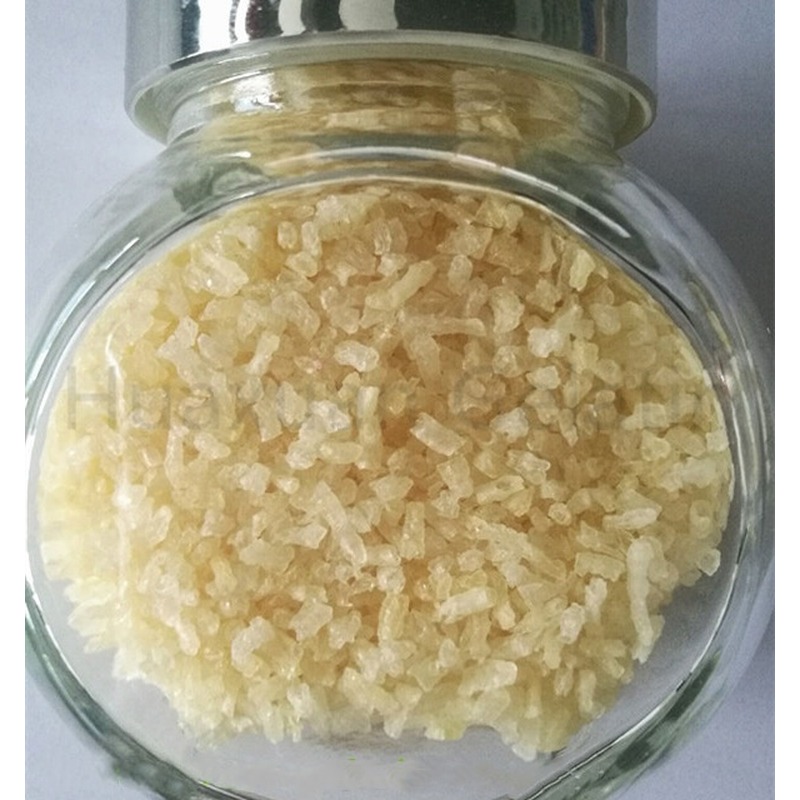
What is gelatin in one line? It is a natural protein made by partially breaking down collagen, the structural protein in animal skin, bones, and connective tissue. It dissolves in hot water, forms a reversible gel when cooled, and tastes of almost nothing. Those three traits — gelling, thickening, and stabilizing — explain its presence in candies, capsules, and countless packaged foods.
Collagen itself cannot absorb into the body or gel in water. Processing changes that. When manufacturers heat collagen in water with acid or alkali, the long protein chains unwind into shorter fragments. The result is gelatin: soluble, colorless, and one of the most versatile food ingredients on earth.
Production Basics
Production follows a simple loop: clean the raw material, loosen the collagen, extract it with hot water, purify, and dry. Two pretreatment routes define the final grade. The acid process makes type A gelatin, mostly from pig skin, and finishes within days. An alkaline route, by contrast, produces type B gelatin, usually from cattle bone and hide, over several weeks.
That difference shapes the product. Type A gelatin tends to be lighter in color, while type B builds a firmer gel and suits pharmaceutical applications. Either way, the extracted liquid passes through filtration, ion exchange, concentration, and drying to become powder, granules, sheets, or instant form.
Sources and Types
Gelatin comes from four main sources, and each brings a different balance of cost, gel strength, and market fit. Roughly 46% of world production starts from pig skin, followed by bovine hide and bone.
| Source | Strength | Typical use | Note |
|---|---|---|---|
| Porcine (pig skin) | High, clear gel | Candy, desserts | Fast processing |
| Bovine (cow hide & bone) | Very high | Capsules, industrial | Strong gel structure |
| Fish (skin & scales) | Moderate | Halal/kosher markets | Lower melting point |
| Poultry | Moderate | Specialty food | Emerging source |
Gel strength also varies within each source, measured as Bloom. A 250-Bloom gelatin sets firm and fast; a 150-Bloom grade melts softer and quicker. Buyers specify Bloom, viscosity, and clarity to match a grade to an application.
Main Uses
The food industry consumes the most gelatin. Gummy candies, marshmallows, yogurt, ice cream, and aspic all lean on its gelling and stabilizing power. In bakeries it holds moisture and improves structure, and in low-fat spreads it restores a creamy mouthfeel.
Pharmaceuticals rank second. Gelatin forms the hard and soft capsule shells that protect medicines, chosen for its biocompatibility and quick dissolution. Industrial uses complete the picture: adhesives, photographic materials, and biodegradable packaging films that replace plastic.
Market data explains the attention: global sales reached roughly $4 billion in 2024, and analysts expect about $6.3 billion by 2031 on the back of clean-label food trends and rising capsule demand.
Why buyers keep coming back
Thermoreversible — melts on heating, sets on cooling, no chemistry needed.
Clean label — a recognizable natural protein, not a synthetic gum.
Multi-functional — one ingredient gels, thickens, stabilizes, and binds.
A Quick Buyer Checklist
Ordering gelatin for production is straightforward once you know the questions. Start with the certificate of analysis — Bloom, viscosity, clarity, moisture, and microbiology per batch. Then confirm the source (porcine, bovine, fish, or blend), because labeling, allergen, and halal or kosher requirements hinge on it. Finally, ask about form: powder for most lines, leaf for precision work, instant for quick dissolution.
A supplier with stable output and export experience removes most of the risk. Xiamen Huaxuan Gelatin has produced food-grade gelatin since 2006 and ships to customers worldwide with full documentation, custom packaging, and batch-level quality data.